
A Look at How the Internet Feeds Us Pseudoscience Dressed as Facts
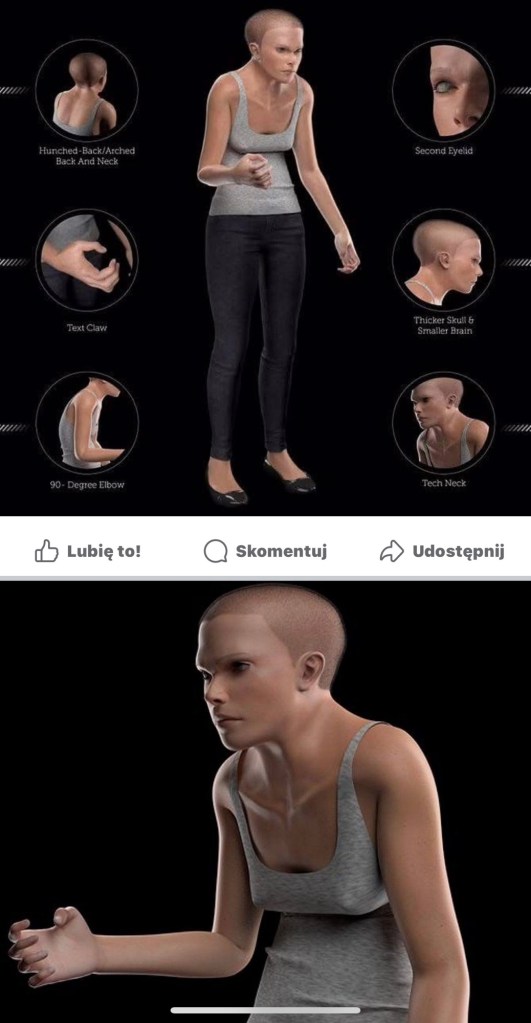
Recently, I came across a viral image supposedly showing the “human of the future” — hunched over, with a thicker skull, a smaller brain, a “text claw,” and even… a second eyelid. Sounds absurd? That’s because it is. This isn’t science — it’s a speculative artistic concept. And yet, many people take it at face value.
In a world where we scroll through dozens of headlines a day, it’s getting harder to separate fact from fiction — especially when fiction is dressed up in scientific language, complete with 3D renders and scary predictions.
The truth? It’s less dramatic — and honestly, a bit boring.
Yes, our bodies do respond to technology. We get neck pain from looking down at phones, wrist strain from typing, and poor posture from sitting too long. But that doesn’t mean that in a few centuries, we’ll evolve into creatures with no chin and permanent smartphone claws.
Why? Because evolution doesn’t work that way. Slouching over your phone for ten years doesn’t mean your kids will be born with shorter necks. Evolution requires thousands of years and very specific environmental pressures to create permanent genetic changes. And let’s not forget — technology evolves too. Just like we moved on from floppy disks and Nokia phones, our screen habits will evolve (or disappear) as new tools emerge.
So why do people create and share this stuff?
Because it gets clicks. It shocks, it fascinates, it scares. And in the battle for attention, nothing works better than a disturbing visual with a dramatic headline.
But that’s exactly why we need to stay sharp. Not every infographic labeled “scientists predict” is backed by actual science. And not every self-proclaimed “expert” online is worth listening to.
What can we do?
Pause and think. Just because it looks scientific doesn’t mean it is. Check the source. Is there a research institution behind it, or a marketing team? Don’t spread nonsense. Even if it’s “fun” or “interesting.”
The world is fascinating enough without made-up second eyelids. While it’s fine to laugh at things like “future human Mindy,” let’s not fall for every clickbait dressed as a prediction.
 FocusZen® by Ange
Dodaj komentarz